

It’s been a whirlwind couple of weeks, but I’m SO happy to be back in Asia!
I’m in Thailand after the most epic celebrations for my best friend’s wedding, now enjoying a bit of R&R before I go back full time to my legal innovation role in Singapore next week.
I’m writing this from the pool, my heart full of love and my head full of ideas, and I’m soooo ready to get started!
Anyway, this week’s issue is shorter than usual because it’s been a little busy over here.
At the wedding, a friend told me about a simple visualisation that helped her make 1 of the biggest decisions of her life: whether she wanted children.
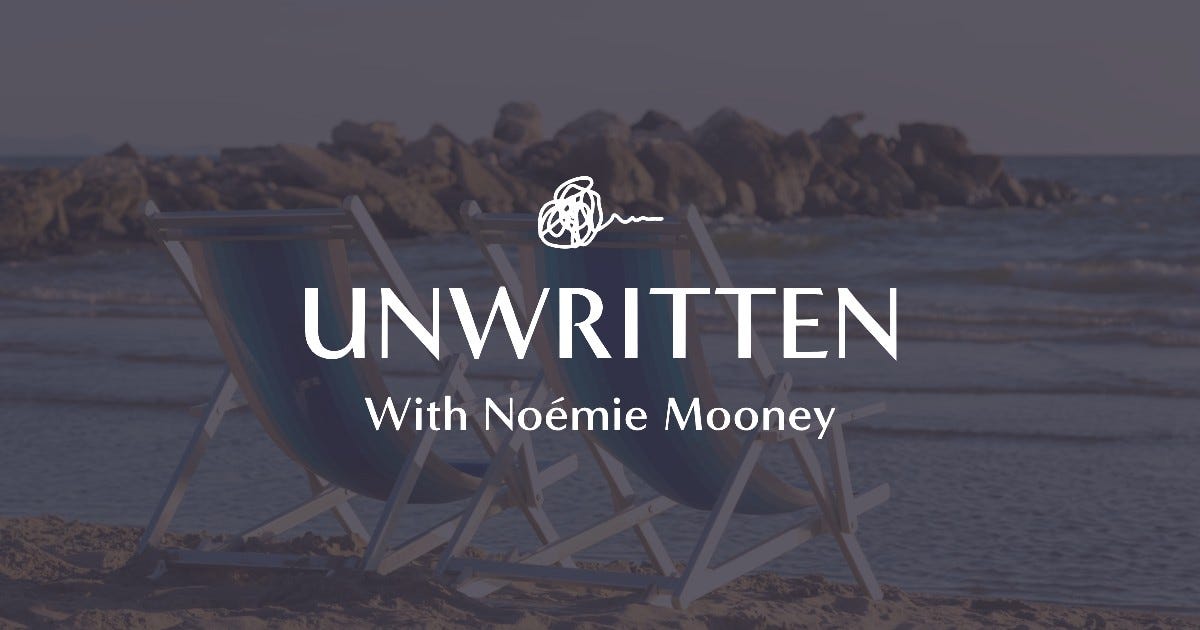
She imagined 2 chairs. In 1, she pictured her life without children. In the other, her life with them.
She sat in both, in her head. And it became obvious to her that she wanted a family.
Until my coaching training, I always found visualisations a bit too woo woo for me.
Then I did one before my marathon, to prepare myself for the tough moments on the course. And honestly? It was super helpful.
(Fun fact: dreamy visualisation can actually backfire. In 1 study, graduates who daydreamed most about their dream job got fewer offers and were earning less 2 years later. What helps is picturing the hard bits, which is exactly what I’d done.)
My friend did something different again. She stepped into 2 possible futures and met the woman she’d be in each one.
Future you is a stranger, so it’s worth getting to know them
I often imagine being old, looking back, and wondering what 80-year-old Noémie would think of me in this present moment.
Would she be proud?
Would she be grateful for the choices I’m making for us right now?
Would she laugh at the things I’m stressing about?
Would she thank me for the body I’m looking after for her?
Would she wish I’d been a little braver?
And it turns out there’s actual science behind my little chats with 80-year-old Noémie (phew, it’s not just me being woo woo again).
Researchers at Stanford put people in a brain scanner and asked them to think about themselves 10 years from now, and their brains reacted more like they were thinking about another person than about themselves. ANOTHER PERSON!
Basically, future you is someone you’ve never actually met. Of course you don’t make choices for them.
Go and introduce yourself, because it changes what you do today.
In another study, people spent 2 minutes writing a letter to themselves either 3 months or 20 years in the future. The ones who wrote to their 20-years-older self said they exercised about 40% longer over the next few days.
All from a 2-minute letter!
That’s exactly what’s changed for me.
I used to work out for my bikini body. Now I move for 80-year-old me.
I eat well and look after myself so she’s mobile and healthy in the future. And honestly, that matters to me more than any bikini ever did.
Regretting some of your past is different from regretting your life
80-year-old Noémie won’t only care about how she moves, though. She’ll also care about what she gets to look back on.
Living without some regrets is kind of inevitable. I certainly have plenty.
Still, I’ve thought about this a lot this year.
If I died tomorrow, I’d be grateful I lived the life I did.
I went on adventures, loved deeply and wholeheartedly, danced and laughed and explored the 4 corners of the world.
In short, I’d die with no regrets.
Which sounds a bit rich from someone who just told you she has plenty of them.
But here’s the difference.
I absolutely regret some of the shit I did in the past, and that’s done, it’s part of the story now. But these days I’m trying to live in a way that 80-year-old Noémie would be proud of, and honestly, that changes a LOT of my choices.
You can’t undo the shit you’ve already done. But you totally get to choose what 80-year-old you looks back on.
So, want to meet yours? It’s 1 of my favourite coaching exercises and it only takes 10 minutes.
⚡️ Try this: your 80th birthday
Picture the party. Close your eyes (yes, really) and imagine your 80th birthday. Where are you? Who’s there? What’s on the table? Cake, obvs.
Listen to the speech. Someone you love stands up, clinks their glass and gives a speech about your life. What are they thanking you for? And what do you secretly wish they’d say? Scribble down whatever comes first, no editing allowed.
Pick 1 thing for your body. Now choose 1 small thing 80-year-old you would be grateful for this week: a walk after dinner, lifting something heavy, going to bed before midnight for once. Then DO it! And jot down what’s most likely to get in your way, plus what you’ll do when it does (because it will).
Your life doesn’t need to be perfect, or regret-free (mine certainly isn’t!). It just needs to be one you’ll be glad you had when you’re blowing out those 80 candles.
I’d LOVE to know what 80-year-old you said. Hit reply or leave a comment, I read every one.
Pull up a chair. Actually, make it 2.
With love,
Noemie x
What did 80-year-old you say?
Key Sources
Gabriele Oettingen and Doris Mayer, ‘The Motivating Function of Thinking About the Future: Expectations Versus Fantasies’ (2002) 83(5) Journal of Personality and Social Psychology 1198 <https://doi.org/10.1037/0022-3514.83.5.1198>.
Hal Ersner-Hershfield, G Elliott Wimmer and Brian Knutson, ‘Saving for the Future Self: Neural Measures of Future Self-Continuity Predict Temporal Discounting’ (2009) 4(1) Social Cognitive and Affective Neuroscience 85 <https://doi.org/10.1093/scan/nsn042>.
Abraham M Rutchick, Michael L Slepian, Monica O Reyes, Lindsay N Pleskus and Hal E Hershfield, ‘Future Self-Continuity Is Associated With Improved Health and Increases Exercise Behavior’ (2018) 24(1) Journal of Experimental Psychology: Applied 72 <https://doi.org/10.1037/xap0000153>.
Noemie Mooney is an ACE Certified Health Coach, ICF-trained Behaviour Change Specialist, certified yoga instructor, and creator of the MAKE SPACE Method™. Trained in design thinking at the Stanford d.school, she writes Unwritten Potential, a newsletter about evidence-based wellbeing, sustainable habits, mental wellbeing, and health behaviour change for smart, health-curious people who want to feel their best without making it a full-time job.